
Academies and learned societies are organisations that bring together outstanding scientists and scholars – so, a kind of club of eminent scientists from different disciplines. Membership is reserved for those with exceptional scientific achievement and is typically granted through election by existing members.
Academies exist in almost all European countries and beyond. They vary widely in size, resources, and in the roles they play within national science landscapes. Some operate solely as learned societies of members or fellows, while others also conduct their own scientific research.
Despite this diversity, the core responsibilities of European academies have remained remarkably consistent across countries and centuries. They provide scientific advice to policymakers and society by publishing scientific reports and studies, organising conferences, facilitating scientific and public debates, and fostering international exchanges. Furthermore, they also confer prestigious prizes – for example, the Royal Swedish Academy of Sciences, which awards the Nobel Prize in Physics and Chemistry each year.
Types of Academies: A Comprehensive Overview
There are different types of academies and most of the countries have more than one academy:
Academies of science
In most countries, there is one national academy of science, usually the largest academy in the country. These academies often divide their activities into ‘classes’ which represent different areas of science (broadly understood), such as natural, medical, health, agricultural and social sciences, engineering and technology, and humanities. Our networks also include academies of sciences representing national, regional or local expertise, such as the Royal Society of Edinburgh, academies of the German Länder, and the Royal Academy of Sciences and Arts of Barcelona.
A unique academy of science is Academia Europaea, established in 1988 with nearly 6000 members from all across Europe and beyond. As a pan-European academy, Academia Europaea is a member of SAPEA in its own right.
Academies of medicine
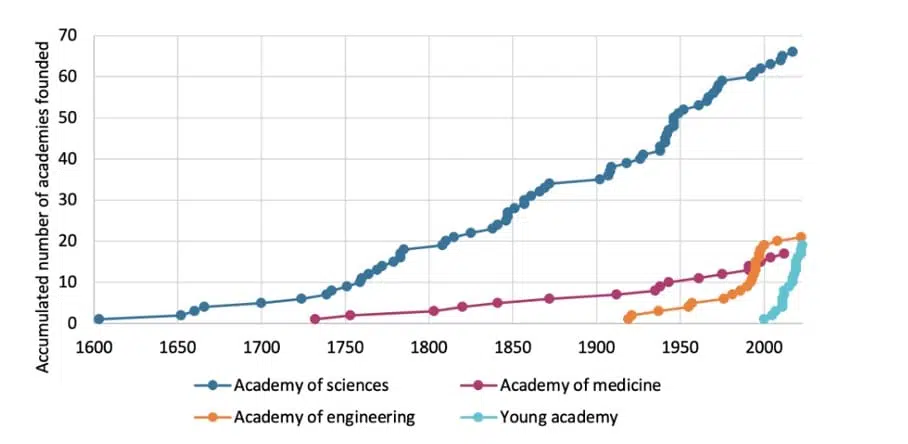
Some European countries have an academy of medicine which is separate from the academy of sciences. The earliest such academy was founded in 1733, the Real Academia Nacional de Medicina de España.
Meanwhile, some national academies of sciences have a specialist medical science section or include medical sciences within their overall remit, such as the Academy of Athens. Altogether, more than 20 academies are organised today in the academy network FEAM, which is a member of SAPEA.
Academies of engineering and technology
Academies of engineering and technologies were established a few centuries later than academies of sciences and medicine, alongside the late phase of industrialisation, electrification and the use of internal combustion engines. The first one was founded in 1919: The Royal Swedish Academy of Engineering (IVA). Today more than 20 academies of engineering and technologies are organised in the academy network Euro-CASE which is a member of SAPEA.
These academies typically gather researchers, innovators and engineers with expertise in technology, engineering and applied sciences both from academia and industry. Some of them also work with entrepreneurs, and others include members from other disciplines such as social sciences related to technology. Some have two pillars: one made up of elected academic fellows (members), and the other being made up of industry or other representatives.
Young academies
Young academies are created to give a voice to early-career scholars, typically limiting membership to a four- or five-year term. When the Berlin-based Die Junge Akademie was founded in 2000, it was the first young academy in the world. Today, almost 20 young academies are organised in the academy network YASAS which is member of SAPEA.
Young academies are often supported by ‘senior’ academies with varying degrees of involvement and independence. In some cases, senior academies act as hosts and provide financial or administrative support, while others are collaborating organisations.
Other types of academies
More specialised academies of experts and practitioners exist, such as academies of veterinary sciences, pharmacy, agriculture and academies of literature and arts. Some of them are members of a European academy network.
How large are academies?
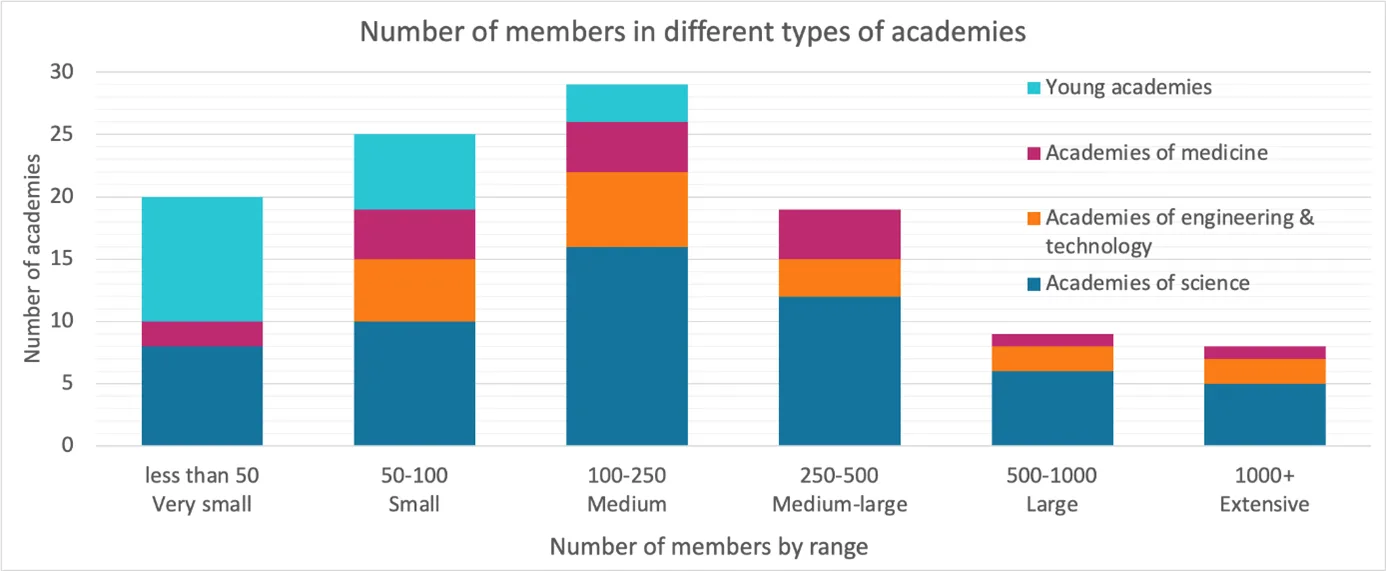
The size of academies in Europe varies greatly. Some have fewer than 50 fellows (members), while a few have more than 1000.
How are academies funded?
According to SAPEA’s survey of academies in 2024, the most common source of funding for European academies is institutional funding from national or local government. About a quarter of academies said that this was over 80% of their total funding.
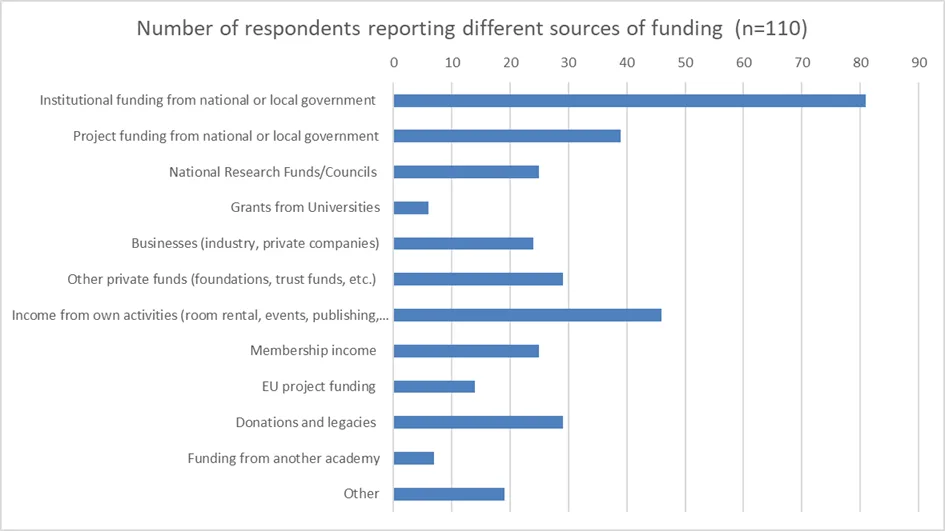
Source: SAPEA survey of European academies, 2024
How old are academies?
Inspired by Plato and the foundation of the ancient Academy in Athens around 387 BCE, the earliest modern academies originated in Renaissance Italy. Among them is the Accademia Nazionale dei Lincei, which was founded in 1603 and is considered the world’s oldest academy.
Other early European academies include:
- the German National Academy of Sciences Leopoldina, founded in 1652
- the Royal Society in London, founded in 1660
- the Académie Royale des Sciences in Paris, founded in 1666
Many more academies were gradually founded across the eighteenth, nineteenth and twentieth centuries. Today, the academy landscape of Europe continues to evolve, most notably through the recent growth of young academies aiming to support early- and mid-career researchers and their inclusion in the science-policy interface.