Tina Comes presented the SAPEA Rapid evidence review report on Artificial Intelligence in Emergency and Crisis Management during the International Telecommunication Union (ITU) Workshop on Resilience to Natural Hazards through AI Solutions, held on December 11, 2025, at Square Brussels.
The report was met with an enthusiastic reception. Following the presentation and during the subsequent break, Tina engaged with numerous participants who were eager to discuss the findings and ask questions. The conversations brought together people from diverse backgrounds, including emergency response teams, policy-makers, technology experts, and standardisation professionals, all interested in exploring the role of AI in crisis management.
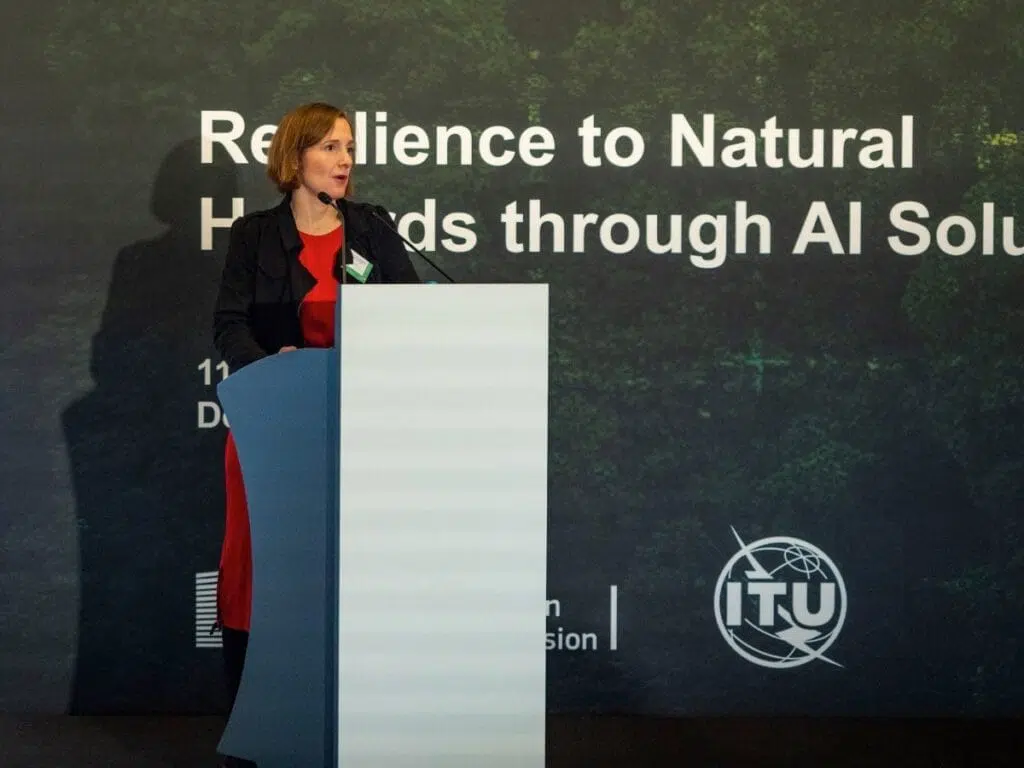
“Crises cross borders, but data is managed at the national level, leading to different standards. This diversity can lead to fragmentation in the data landscape that AI cannot easily bridge. Data preparedness is an important step to connecting these data systems that provide the necessary foundation for AI to provide effective decision support in European crisis management,” explained Professor Tina Comes, chair of the SAPEA working group on Artificial Intelligence in Emergency and Crisis Management.
Presented to Maciej Popowski, Director-General of DG ECHO, the report emphasises that while AI offers significant potential for enhancing crisis response, it must be implemented with careful attention to human dignity, transparency and responsibility. The evidence gathered by SAPEA's network of prominent scientists shows that AI excels at standardised, data-intensive tasks such as monitoring floods, wildfires, and droughts, and can process social media and damage assessments at unprecedented scales and speeds. However, the report cautions that AI struggles to interpret heterogeneous contexts or novel situations, and that morally challenging decisions must remain under human control.
The RERR underlines Europe’s fragmented data landscape. Policy options to address this could include a new European crisis management data preparedness framework with common standards and sharing protocols to enable the development of effective EU-wide AI tools. The potential added value of benchmarks, practical guidelines, codes of conduct, and sandbox environments to test AI systems under supervision and ethical oversight before full deployment is also underlined.