
What brought everyone together here today?
The Academy hosted an event devoted to the use of artificial intelligence in crisis and emergency management, and what it means, more broadly, to understand and communicate disasters. The day was dedicated to several dimensions of this question. First and foremost: the role of human intervention in decision-making. How can we ensure that decisions are taken by humans and not by machines?
But there were many other threads of discussion: more technical ones, about how to use these methods in practice, and more ethical ones, about what it means to use them. How do we avoid fake news generated by algorithms? And not only by algorithms, because humans can also generate fake news and disseminate them. The spread of misinformation during emergencies is a serious problem. The event tried to cover all of this: how to make the best possible use of artificial intelligence to support human management and decision-making in emergencies situations.
You moderated the discussions throughout the day. What, in your view, is the most important takeaway?
I think there were several things that really stood out. The first is that artificial intelligence methods, and large language models in particular, can genuinely help in speeding up the management and analysis of data, and in that way support the human role. This, however, requires the presence of disciplinary experts. The importance of having a specialist in the specific field, whether that is climate science, droughts, floods, economic crises, wars, or any other kind of disaster, is absolutely crucial. We cannot hand artificial intelligence the sole ability to interpret data.
A second problem that emerged is the gap between research and action. We study what to do, we look at what to do, and that takes time. But while we are doing that, the methods and approaches are evolving very rapidly. So how do we combine the need for speed with the need for rigour in understanding what is happening at this very moment?
Then there is the question of communication. It is not just understanding but properly communicating what should be done. Lastly, something I found particularly striking is that we cannot rely solely on the Internet. In many parts of the world, including in Europe, Internet access is simply not widespread. This is even more true as, during a disaster, Internet connectivity may fail, so we need to find other ways to reach people. Ultimately, it really comes down to the human-machine interface.
Interview conducted by Justine Moynat
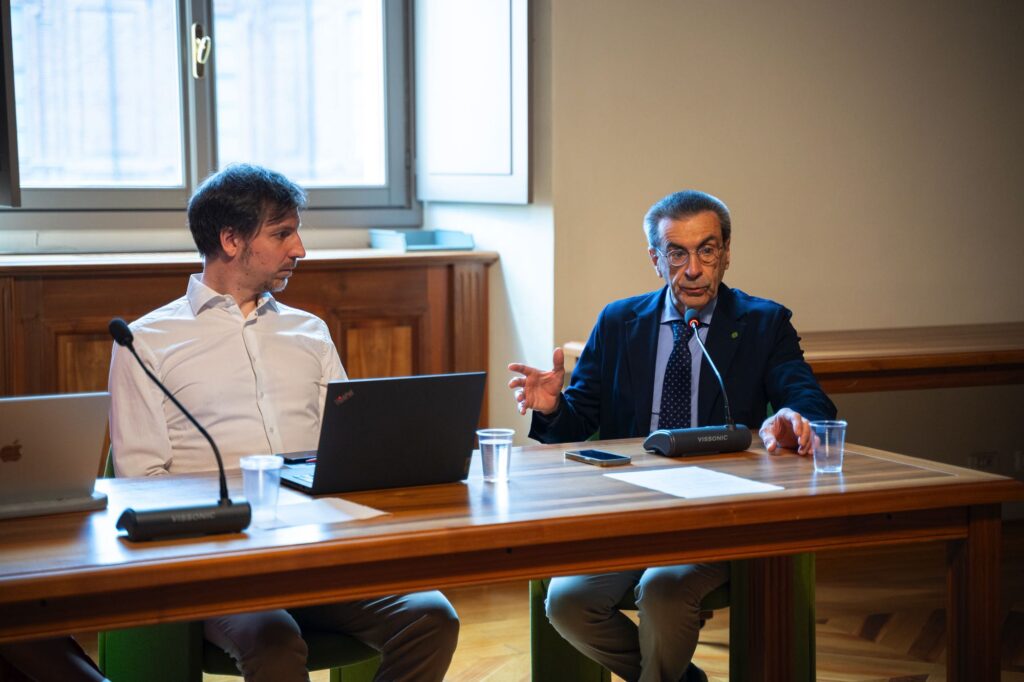
About the event
"AI for Crises and Emergencies: Understanding and Communicating Disasters" was organised by the SAM, together with the Accademia delle Scienze di Torino and ALLEA on 12 June 2026.
The event drew on SAPEA’s recent evidence review report Artificial Intelligence in Crisis and Emergency Management and the accompanying statement of the EU’s Group of Chief Scientific Advisors. Speakers explored AI’s potential to improve hazard prediction and disaster analysis alongside its well-documented risks: AI-generated disinformation, hallucinations in large language models, algorithmic bias, and the inadequate representation of vulnerable populations.
Topics ranged from the Copernicus Emergency Management Service and AI-assisted early-warning systems to misinformation dynamics and the promise of agentic AI and chatbots for personalised emergency communication. A recurring tension was the “Goldilocks dilemma”: AI tools that go unused offer no benefit, while those adopted uncritically risk eroding the very human expertise they are meant to support.
Antonello Provenzale
Antonello Provenzale graduated in Physics in 1982 and completed his doctorate at the University of Turin in 1987. A Senior Research Director at the Italian National Research Council (CNR), he served as director of the CNR Institute of Geosciences and Earth Resources from 2015 to 2024. His current research focuses on planetary climate dynamics, the impacts of climate change on ecosystems, the water cycle and the carbon cycle, Critical Zone processes, wildfires, changes in mountain environments, geosphere-biosphere interactions, environmental modelling, and the development of Virtual Research Environments.
He was awarded the Golden Badge of the European Geophysical Society in 1997, and has held visiting positions at the École Normale Supérieure, the Université Pierre et Marie Curie in Paris, Ben-Gurion University of the Negev, and the University of Colorado Boulder.
He currently coordinates the GEO Mountains Initiative and the EuroGEO Action Group on Biodiversity, Ecosystems and Geodiversity, and serves on the Research Infrastructure Committee of the European research infrastructure LifeWatch ERIC.